
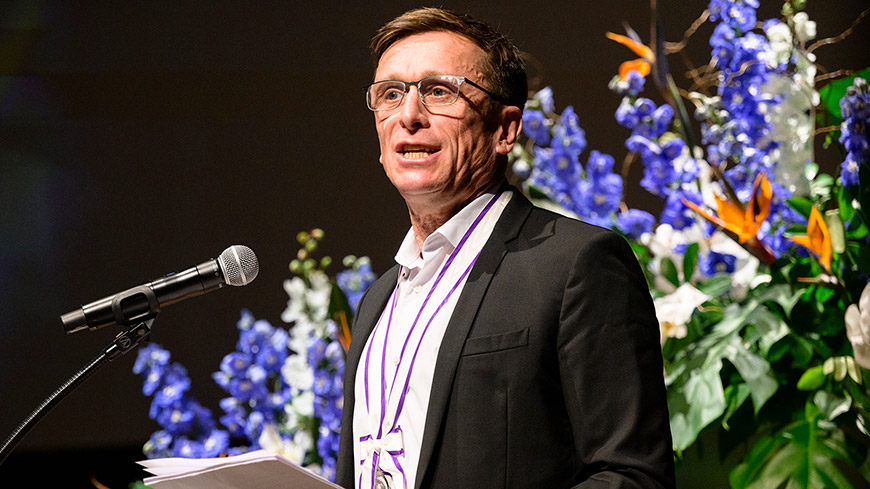
Jeremy Gilley MBE
It is a profound honor to stand before you today and accept, in all humility, the Goi Peace Award. I wish to express my deepest gratitude to the Goi Peace Foundation for this recognition and for its enduring commitment to fostering peace, wisdom, and harmony among all people.
As I reflect on this journey, I want to take you back to 1999, when the dream of establishing a Peace Day with a fixed calendar date, a day of global ceasefire and non-violence on the UN International Day of Peace, #PeaceDay first took shape.
This was not a journey I walked alone. It became possible because of extraordinary organizations and individuals who supported me – people who flew me around the world and helped me make every step of that vision a reality. From Jude Law to Dr. Oscar Arias, from Angelina Jolie to Kofi Annan, from Dave Stewart to Mary Robinson, and from Ahmad Fawzi to Hamid Karzai, from diplomats to everyday heroes, so many gave their time and support. It was a collective effort that took me through Afghanistan, Australia, North America, the Democratic Republic of Congo, Costa Rica, Egypt, Gaza, India, Kenya, Somalia, Sudan, and so many other countries, in fact 162 countries, building the case for this day of Peace with a fixed calendar date.
Eventually, the British and Costa Rican governments put forward the resolution and with many co-sponsors, it was unanimously adopted by the United Nations General Assembly on 7th September 2001.
I remember waiting for UN Secretary General Kofi Annan on the morning of September 11th, 2001, at United Nations Headquarters in New York, ready to announce the creation of this day, this achievement to the world. That announcement never came – it was overshadowed by the tragedy of 9/11. But it was in that darkness, that horrific moment that I realized that we had to continue our work. When faced with darkness, we have a choice: to let it defeat us or to seek out the tiniest crack of light and chip away until it grows. That is the essence of resilience, of a belief in the truth. And truth is all we have. The rule of law, the basis of everything.
I truly wanted to prove that a day of ceasefire and non-violence could work, even in a place as complex as Afghanistan, so the cynics would have nothing left to say. Cynics are cynical; it means they don’t have to do anything. If they say that you can’t climb that mountain or that peace isn’t possible, then naturally, it means that they don’t have to try, it’s interesting. It’s humans; it’s the way some people operate.
After years of effort, and not listening to the cynics, and with the incredible support of my dear friend and Peace One Day ambassador Jude Law, we made it happen; it worked. In 2007, with the dedication of UN agencies, UNICEF, the WHO, and other local organizations, NATO, and ISAF – the Taliban agreed not to kill or kidnap people in certain hostile areas, allowing 10,000 vaccinators to reach areas they couldn’t normally access. It was absolutely incredible. 1.4 million children in that first year were vaccinated against polio, and the United Nations Department of Security and Safety announced a 70% reduction of violence across the country. It was unbelievable, and that entire story of creating the day, to manifesting the first ceasefire in Afghanistan is told through our film “The Day After Peace.” The 70% reduction of violence, measuring a decrease in violence became really interesting.
I started to learn about the theory of marketing and behavioral change. You expose someone to a message, a certain number of those people remember the message and then a percentage of those people purchase, and in this instance, they change their behaviour. So therefore, asking global companies like Puma and Adidas to come together to make peace became a huge press story. That idea inspired the McWhopper campaign, which saw McDonald’s and Burger King try to do the same. Unilever’s ‘Make Love Not War’ Campaign, with the commercial opening the Super Bowl and putting the Peace One Day message “The Day of Peace” on the Coca-Cola can. This is institutionalization. This is exposure. The awareness of these campaigns was enormous. That is why now, after all these years, because of those strategic initiatives, because of concerts, social media activation, educational resources that we produce, mobilizing individuals and organisations all over the world. Peace Day 21 September is the day where more people think about peace than any other day of the year, and the day when there’s the greatest reduction of violence. Institutionalization, and behavioral change. That was a mission, and it was becoming accomplished. Incredible to watch.
But ultimately, I realized that if we want real peace, then we have to address other fundamentally important issues with constructive narrative that informs, inspires and engages people such as education, the elimination of racial discrimination, AI, climate action, mental health, food, the elimination of violence against women as well as many other issues. All of these things are fundamentally important to the possibility of peace becoming a reality, and that’s why Peace One Day streams content, constructive narrative on international days that relate to our survival.
People often ask me, “Why did you go on this journey? What made you want to create a Day of Peace?” And I think the answer lies in my childhood. When I was growing up, I was confused, I was frightened, I’m badly dyslexic, I was bottom of the class, I had no qualification. I was medically small – so at times I was bullied. School was difficult, at home it was uncomfortable, sometimes frightening. But all of those experiences lit a fire inside of me that has fueled everything I’ve done. I have no doubt about that.
That’s why I became a filmmaker. I was an actor from the age of 12 to 26. I escaped the difficulties of my childhood and school life when I played the lead role in a West End musical called Bugsy Malone, in London. What was interesting about that character of Bugsy Malone, is that he is a peacemaker between two gangs; he wanted to bring people together. In essence the musical is about making peace, it was all about “If you give a little love, it all comes back to you.” The character freed me and shone a light in a new direction.
I continued to act, but it got to a point where I realized that doing another Shakespeare play or another TV programme, wasn’t feeding my soul. I wanted my life’s work to have meaning; to contribute in some way. So, at the age of 28, I had the idea of making a film about creating a Peace Day with a fixed calendar date.
When choosing the date for the day of peace, I thought of my grandfather, who was a British prisoner of war in a Japanese prison camp near Nagasaki. After the two nuclear bombs were dropped, which ended the war, my grandfather came home. His favorite number was 21 – because 21 of his friends made it back to their families. He died from blood poisoning, when I was 11. He wasn’t to know his favorite number would become the world’s day of peace. That September 21st would become the day when more people think about peace than any other day of the year and the day where there is the greatest reduction of violent deaths, and growing annually, according to reliable resources, and that was incredible.
So, I accept this award not only for him, but for my family, for everyone who has supported me on this path, and for anyone who has lost loved ones due to conflict, or anyone who might find themselves being forced into a corner. That’s tough, and I stand here for you.
If you want somebody to talk to you about peace, then I would recommend you find somebody who has had their peace taken away from them. And I know what it’s like to have your peace taken away. I know what darkness is. I know what standing on the edge feels like. I held my breath; I stayed calm – because human beings will invent things and now talk about them until they believe they’re true in order to achieve their desired outcome. It’s absolutely astonishing, it’s deeply worrying, and it’s the reason why we have so much conflict in our world. That’s what you see in politics, in our homes, in communities, schools and places of work – people inventing realities not because they’re clever, but because they’re weak. They want power; they want control. Humans talk a great talk, but we are not capable when it comes down to it, of protecting what should be the mission of human beings: To be guardians of this beautiful planet and each other. Because the truth, in some cases, for some people, doesn’t give them their desired outcome and that’s why they make up a new story. That is when you see the dark side of human behaviour.
So I stand here as passionately as I can on behalf of those who can’t. That’s why I never gave up. I took pictures of people who could never walk away, while I had the privilege of being able to do so. But when you have a gun pointed at you, when you’re pushed into a corner, when you’re humiliated or bullied – stay calm, stay strong, take a deep breath, find the light, and never give up, it will be okay.
No matter what happens, your lives have meaning, it’s worthwhile. And if we are ever going to change the status quo, to shift our collective consciousness, it will be because we faced the darkness, we stood strong, we stood together, we interculturally cooperated, we united, separate from politics, religion or colour and we refused to hate, to pick up weapons.
In the midst of all this recognition, there is a stark reality I need to share. Despite being celebrated as a peacemaker, the reality is that I am constantly struggling on the brink of financial survival, dealing with debt on a daily basis. There is so little investment in peace compared to the vast sums poured into war. If we lived in a world that valued peace as much as it profits from conflict, we’d see flourishing economies and thriving societies. Instead, peace efforts like mine are left to survive on a shoestring. The truth is, you have to be able to live and manage debt if you want to become a peacemaker because there is very little investment. I am doing my best with the tiniest of resources, and that in itself shows how much the world still needs to change. It has to invest more in peace, and those on the front line.
And so, I stand before you with the unwavering belief that we are at a pivotal moment of reckoning. Just as an individual transforms when they reach their own rock bottom, we as humanity can find our awakening. I get up every day and work for this hope, because I believe we can shift from a world driven by greed and power to one grounded in the protection of our planet and each other. This is our turning point, our collective awakening, and together, we can redefine what truly matters.
I want to end today with one closing thought; the United Nations is the closest organisation we have to holding the world together, and I have always wanted to do everything I can to support it. The most inspiring room on this planet, for me, is the General Assembly of the United Nations. Founded in 1945, and the opening lines of the Charter of the United Nations are among the most inspiring words I have ever read:
“We, the peoples of the United Nations, determined to save succeeding generations from the scourge of war…and to reaffirm faith in fundamental human rights, in the dignity and worth of the human person, in the equal rights of men and women and of nations large and small…”
We cannot let the United Nations be disempowered and weakened. The UN has a hard journey ahead, but “We the peoples…” can stand up and be a part of uniting our nations. Perhaps we need to accept that we have failed, at this point, in what should be our greatest challenge: to protect each other and our planet. From that place of acceptance, we might be able to change and shift the level of consciousness around the fundamental challenges we face.
And that is why storytelling, constructive narrative, that informs, inspires, engages people towards action that is measurable, is critically important. If we want the status quo to change, storytelling is the gateway.
This Goi Peace Award has fueled my passion to spend every day that I have left, to do exactly that. Thank you to the Goi Peace Foundation for the inspiration and for this award. Thank you to the people of Japan, this incredible country that truly knows what peace is, having lost so many loved ones.
It is by working together, and standing together that we can and we will, if we so choose, have Peace One Day.
Thank you.